The Science of Why Video Diaries Are Better Than Photo Albums for Memory
 Allison HewellFebruary 20, 202612 min read
The Science of Why Video Diaries Are Better Than Photo Albums for Memory
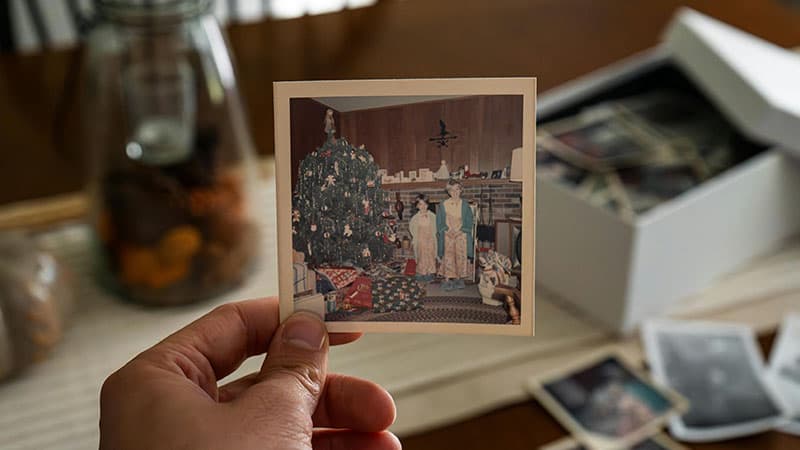
Think about the last time you opened an old photo album. You saw faces, places, maybe a birthday cake or a sunset. You recognized the moment. Now think about the last time you watched an old video, even a short one. You heard the laughter. You noticed the mess in the background, the way someone moved, the tone of a voice you had almost forgotten.
One of those experiences gives you information. The other one takes you back.
That difference is not just emotional. It is rooted in how your brain encodes, stores, and retrieves memories. And the research behind it has real implications for how you choose to document your life.
A photograph shows you what something looked like. A video reminds you what it felt like.
How Your Brain Stores Memories
In 1972, cognitive psychologist Endel Tulving proposed a distinction that changed how we understand memory. He described two systems: episodic memory and semantic memory.
Semantic memory stores facts and general knowledge. You know that Paris is the capital of France. You know what a birthday party looks like. This type of memory is detached from personal experience.
Episodic memory is different. It stores personally experienced events bound to a specific time and place. It includes sensory detail, emotion, and what Tulving called "autonoetic consciousness," the feeling of mentally traveling back in time and re-living the moment.
When you look at a photo from a vacation five years ago, you might activate semantic memory. You recognize the location. You remember the trip happened. But when you watch a video from that same trip, with the sound of the street, the laughter of the person next to you, the way the camera moved as you walked, you are far more likely to activate episodic memory. You do not just remember. You re-experience.
This matters because episodic memories are the ones that feel like *yours*. They carry emotional weight. They connect you to your past in a way that facts and snapshots cannot.
Tulving's 2002 review in the Annual Review of Psychology remains one of the most cited papers in memory science, and the episodic-semantic distinction is now a foundational concept in cognitive psychology.
The Dual Coding Advantage
In the 1970s, psychologist Allan Paivio at the University of Western Ontario developed what he called dual coding theory. The idea is straightforward: your brain processes information through two channels, a verbal channel (language and words) and a nonverbal channel (images, sounds, and spatial information). When you encode something through both channels at the same time, you create two separate retrieval paths instead of one.
A written journal entry gives you one channel. A photograph gives you one channel. A video gives you both, plus motion and temporal flow.
This is not a small difference. Clark and Paivio's 1991 review showed that dual-coded information is consistently remembered better than information encoded through a single channel. The more ways your brain can access a memory, the more likely it is to stick.
When you record a short video of your child playing in the yard, your brain encodes the visual scene, the sound of their voice, the movement, and the context all at once. That clip becomes a multi-path memory anchor. A photo of the same moment, while valuable, only gives you one of those paths.
Why Multi-Sensory Memories Last Longer
Dual coding theory focuses on verbal and visual channels, but the story goes further. Your brain evolved to learn from environments that engage multiple senses at once.
Ladan Shams at UCLA and Aaron Seitz at UC Riverside published a landmark review in 2008 showing that multisensory experiences are remembered better and longer than single-sense inputs. Objects experienced through combined visual and auditory channels are identified faster, attended to more readily, and retained more reliably.
A 2025 study published in Memory and Cognition found that encoding audiovisual experiences improves memory not just for the objects themselves, but for the environments in which those objects were encountered. Video captures exactly this kind of rich, multi-sensory context.
This is why watching an old video can feel so vivid. The combination of sound, motion, and visual detail creates a memory trace that is denser and more durable than what any single medium can produce. Your brain has more hooks to grab onto when it tries to pull the memory back.
Context Is Everything
There is another layer to this: context-dependent memory.
In 2001, Steven Smith at Texas A&M University and Edward Vela published a meta-analysis of decades of research on environmental context and recall. The finding was clear: when the cues present during encoding match the cues present during retrieval, memory improves significantly.
In plain terms, if you are in the same room where you learned something, you are more likely to remember it. If you hear the same background sounds, smell the same smells, or see the same objects, your brain has an easier time finding the memory.
Video preserves context in a way that photos and text simply cannot. A photo shows you a face in a room. A video shows you the room itself, the ambient noise, the lighting, the people moving in the background, the texture of the moment. When you watch it back, those contextual cues trigger the same retrieval pathways that were active when the memory was first formed.
This is why a shaky, poorly lit video of a family dinner can bring back more than a professionally shot photograph. The context is what your brain needs, not the resolution.
The Reminiscence Bump and the Decades You Forget
Memory researchers have known for decades about a phenomenon called the reminiscence bump. When adults over 40 are asked to freely recall autobiographical memories, they disproportionately remember events from between the ages of 10 and 30. Memories from this period are vivid, detailed, and easily accessed.
After 30, the curve drops off. The everyday moments from your 30s, 40s, 50s, and beyond are statistically the most likely to fade.
A 2018 systematic review in PLOS ONE confirmed this pattern across cultures and methodologies. The bump is real, and it is remarkably consistent. Koppel and Berntsen's 2015 review explored several theories for why it happens, including the fact that ages 10 to 30 are packed with novel, identity-forming "firsts" that get encoded more deeply.
The implication is significant. The period of life when most people are raising families, building careers, and living their daily routines is also the period when their brains are least likely to form strong, lasting memories of those routines. Not because the moments are not meaningful, but because they lack the novelty that drives deep encoding.
If you are over 30, the memories you are making right now are statistically the ones most likely to fade. A daily video diary is one of the simplest ways to protect them.
This is where intentional documentation becomes especially valuable. You cannot change how your brain prioritizes novelty. But you can create external memory anchors for the ordinary moments that would otherwise disappear.
The Photo-Taking Impairment Effect
Here is something counterintuitive. Taking photos can actually make your memory *worse*.
In 2014, Linda Henkel at Fairfield University published a study called "Point-and-Shoot Memories" in Psychological Science. She took participants on a museum tour and asked some to photograph objects while others simply observed. The result: people who photographed objects remembered fewer details about them than people who just looked.
Henkel called this the "photo-taking impairment effect." The act of taking a photo allowed participants to mentally offload the memory to their camera, reducing their own encoding effort. This aligns with earlier research by Sparrow, Liu, and Wegner (2011) on the "Google effect," which showed that people remember less when they expect information to be saved externally.
But here is the important nuance. Henkel found that when participants were asked to zoom in on a specific detail rather than photograph the whole object, the impairment disappeared. The act of deliberate, selective engagement counteracted the offloading effect.
This maps directly to the practice of keeping a video diary. Mindlessly snapping dozens of photos throughout the day can weaken your memory of those moments. But choosing one meaningful moment to record, being intentional about what you capture, requires exactly the kind of selective attention that strengthens encoding.
A daily video diary is not about documenting everything. It is about choosing one moment worth remembering and being present with it.
Nostalgia Is Good for You
For most of the 20th century, nostalgia was considered a mild form of depression, a longing for a past you could not return to. Research over the last two decades has completely overturned that view.
Constantine Sedikides and Tim Wildschut at the University of Southampton have led this shift. Their 2008 review in Current Directions in Psychological Science showed that nostalgia is a predominantly positive emotion that serves real psychological functions.
Specifically, nostalgia:
- Boosts mood. People consistently report feeling happier after experiencing nostalgic reflection.
- Strengthens social connectedness. Nostalgic memories almost always involve other people, reinforcing a sense of belonging.
- Increases meaning in life. A 2018 paper by Sedikides and Wildschut found that nostalgia directly increases perceived meaning.
- Fosters self-continuity. Nostalgia helps you feel that your past self and present self are connected, which promotes overall well-being.
Video is the most powerful nostalgia trigger available. It does not just remind you that something happened. It recreates the sensory and emotional context of the original experience, giving your brain the richest possible material for nostalgic reflection.
This is not a trivial benefit. In a world where people increasingly report feeling disconnected and uncertain about meaning, the ability to reliably access positive nostalgic experiences through a video diary has real value.
Building Your Life Story
Psychologist Dan McAdams at Northwestern University has spent decades studying what he calls narrative identity, the internalized, evolving story you construct about your own life.
According to McAdams and McLean's 2013 review, narrative identity is a distinct layer of personality that begins forming in adolescence and continues developing through adulthood. You are constantly integrating your past experiences into a coherent story that gives your life unity and purpose.
The research shows that people who build richer, more detailed life narratives tend to report higher levels of well-being and mental health. People who can find redemptive meaning in difficult experiences, seeing growth come from hardship, tend to be more resilient.
A video diary gives you raw material for this narrative construction. It provides concrete episodes that you can revisit, reinterpret, and weave into your evolving sense of self. Over months and years, these clips become more than memories. They become chapters in a story you are actively building.
What the Therapy Research Shows
The benefits of reflective documentation are not theoretical. Clinical research supports them directly.
James Pennebaker at the University of Texas at Austin pioneered the study of expressive writing in the 1990s. His 1997 paper showed that writing about emotional experiences produces measurable improvements in both physical and psychological health. A meta-analysis by Smyth (1998) across 13 studies confirmed a meaningful effect size across health outcomes including psychological well-being and general functioning.
More recently, a 2018 randomized controlled trial found that positive affect journaling, the practice of writing about positive experiences and emotions, reduced anxiety and mental distress within just one month.
Video journaling extends these benefits by adding sensory and emotional richness to the reflective process. You are not just writing about a good day. You are watching it. Hearing it. Feeling the context return.
There is also evidence that these benefits compound over time. A Cochrane systematic review by Woods et al. (2018) found that reminiscence therapy, the structured recall of past experiences using prompts like photographs, music, and video, significantly reduces depression and improves quality of life in older adults. A video diary built over years becomes a powerful resource for this kind of therapeutic reflection later in life.
The moments you record today are not just for today. They are building a library that will serve you for decades.
What to Look for in a Video Diary App
The science points in a clear direction. Video captures more of what makes a memory a memory. But the tool you use matters.
Based on the research above, a good video diary app should do the following:
- Make capture quick and effortless. The habit needs to be easy enough that you do it daily. If recording a clip takes more than a few seconds, the habit will not stick.
- Store videos locally by default. Your memories should live on your device, not on a server you do not control. Privacy matters, especially for something this personal.
- Auto-compile clips into chapters. The nostalgia and reminiscence benefits only happen if you actually watch your clips back. The app should turn your recordings into watchable chapters automatically, daily, weekly, monthly, and yearly, so you engage with your memories regularly.
- Support gallery import. Life does not happen on a schedule. You should be able to pull clips from your camera roll for any date, past or present.
- Not charge a subscription to access your own memories. A video diary is a long-term practice. The app should respect that with fair pricing.
We built Memovi around exactly these principles. It is a daily video diary app with auto chapters, local-first storage, gallery import, and a one-time purchase instead of a subscription. The free tier gives you 3 clips per day so you can try it before buying anything.
The Simplest Habit That Protects Your Memories
The research is clear. Video encodes memories through more channels, preserves more context, triggers deeper recall, and produces stronger nostalgia than photos or text alone. The reminiscence bump means the everyday moments you are living right now are the most at risk of being forgotten. And the therapeutic benefits of reflective documentation, whether through journaling or video, are well established.
The hard part is not understanding the science. The hard part is pressing record today. But even one second is enough.
Video preserves what photos and text cannot: the sound, the motion, the feeling of a moment. Research shows that these multi-sensory cues are exactly what your brain needs to hold onto a memory. A daily video diary is one of the simplest ways to protect the moments that matter most. Try Memovi free on Google Play.

Allison Hewell
LPC-AContributing Writer & Mental Health Expert
Allison is a licensed therapist specializing in trauma therapy. She writes about the mental health benefits of video journaling and building healthy daily habits.
Connect on LinkedIn